



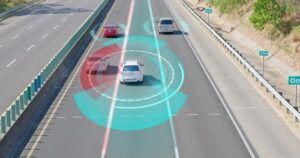
U.S. Reps. John Moolenaar (R-MI) and Dusty Johnson (R-SD) on Sept. 12 proposed a bipartisan bill that would prohibit the U.S. Department of Transportation (DOT) from entering into, extending, or renewing a contract with or awarding a grant to an entity that uses or procures light detection and ranging technology (LiDAR) from certain foreign entities, particularly China.
LiDAR is a remote sensing technology that captures detailed three-dimensional maps of surrounding environments with millimeter-level accuracy. LiDAR is widely utilized in the transportation space within autonomous vehicles, drone inspection of critical infrastructure, traffic control systems, railroad grade crossings, airports, and more.
“America should not rely on this technology from our adversaries,” said Rep. Johnson, who sponsored the Securing Infrastructure from Adversaries Act, H.R. 9565, alongside three original cosponsors, including Rep. Moolenaar and U.S. Rep. John Garamendi (D-CA).
“China’s access to highly detailed maps of our country’s infrastructure, from ports to highways to railroads, is a big threat to our national security,” Rep. Johnson said. “We must keep our sensitive data out of the hands of those who seek to undermine our nation.”
Rep. Moolenaar called LiDAR “a foundational technology of the future” that’s critical to the development of everything from automobiles to roads and bridges.
“By prohibiting the Department of Transportation from using Chinese Communist Party (CCP)-affiliated LiDAR technology, Congress will get ahead of yet another supply chain dependency on the CCP and reduce the party’s leverage over our industries and our country,” said Rep. Moolenaar, chairman of the Select Committee on the CCP.
U.S. firms initially led in LiDAR production, but firms in China are gaining market share at an alarming rate, some while using questionable practices related to U.S. intellectual property, the lawmakers said, noting that these companies are subject to China’s National Security Law, which states that all companies must provide any available data collected by their products and systems to the CCP, when required.
If enacted, H.R. 9565 would prohibit the DOT from utilizing LiDAR from foreign adversaries beginning on June 30, 2026.
The DOT would be prohibited from procuring LiDAR from a covered company, contracting with entities using LiDAR from a covered company, and providing loans or grants to entities using LiDAR from a covered company. Covered LiDAR companies would include any entity on the Consolidated Screening List; any entity on the 1260H list; and any entity that is domiciled or subject to unmitigated foreign ownership by China, Iran, North Korea, or Russia, according to the bill’s text.