



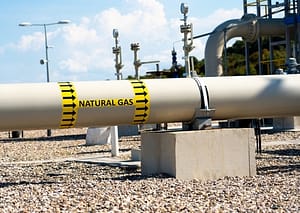
The U.S. House of Representatives on Sept. 18 voted 224-203 to advance legislation led by U.S. Rep. Julie Fedorchak (R-ND) that would streamline the permitting process for projects that connect U.S. energy resources with international markets. The bill is now under consideration in the U.S. Senate.
“The Keystone XL pipeline should have never been cancelled. Yet on his first day in office, President Biden used the stroke of a pen to shut it down,” Rep. Fedorchak said on the House floor. “By passing my legislation, the House has taken a critical step to end years of regulatory uncertainty and partisan games that have delayed energy infrastructure projects, crushed good-paying jobs, and undermined America’s energy security.”
Under current law, the permitting process for cross-border oil, gas, and electricity projects involves a mix of presidential permits, agency-specific procedures, and executive discretion that has all led to regulatory uncertainty, project delays, and in some cases, permit revocations — such as the Keystone XL pipeline, according to the congresswoman.
On April 29, she sponsored the Promoting Cross-Border Energy Infrastructure Act, H.R. 3062, which would allow anyone constructing, connecting, operating, or maintaining a border-crossing facility for the import or export of oil, natural gas, or electricity between the U.S. and Canada or Mexico to be able to obtain a streamlined Certificate of Crossing through either the Federal Energy Regulatory Commission (FERC) or the U.S. Department of Energy (DOE), rather than through the U.S. State Department and president.
Additionally, H.R. 3062 would task FERC with overseeing applications for oil and natural gas pipelines, while DOE would manage applications for electric transmission facilities, according to a bill summary provided by Rep. Fedorchak’s office.
FERC and DOE also would be required to meet specific deadlines for issuing certificates and approving applications for oil, natural gas, and electricity importation or exportation, and the president would be required to receive congressional approval before revoking any previously issued permits under executive orders related to the construction, connection, operation, or maintenance of oil or natural gas pipelines, electric transmission facilities, or any other border-crossing energy infrastructure, the summary says.
Among the organizations supporting the bill are the Edison Electric Institute, the America First Policy Institute, the American Petroleum Institute, Americans for Prosperity, and the National Taxpayers Union, among others.