



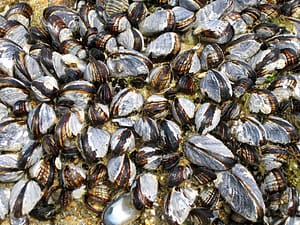
California is in need of federal funds to quash the fast-spreading, invasive golden mussels, which reproduce at exponential rates, clog water delivery systems, and damage water infrastructure, say U.S. Reps. Vince Fong (R-CA) and David Valadao (R-CA).
“Golden mussels pose a serious and growing threat to California’s water supply, environment, and agricultural infrastructure due to their aggressive reproduction and ability to clog pipes and jam pumps,” Rep. Valadao said Tuesday. “We cannot afford to let this invasive species spread further and jeopardize the systems families, farmers, and communities rely on.”
Rep. Valadao and Rep. Fong joined two California Democrats in urging U.S. Fish and Wildlife Service (USFWS) Director Brian Nesvik to make emergency funding immediately available to support state and local response efforts.
“Golden mussels spawn several times throughout the year producing microscopic larvae in numbers reaching up to one million eggs annually per female,” the lawmakers wrote in a June 2 letter sent to Nesvik. “This has led to the unrestrained spread of larvae throughout California and has made eradication efforts especially challenging.”
The members warned that, without immediate federal support, California water agencies, farmers, and communities would continue to bear escalating costs as the invasive species spreads.
“Golden mussel colonies infiltrate critical infrastructure, such as pipelines, pumps, and hydropower systems, by attaching to surfaces, reducing water flow, overheating pumps, and potentially causing catastrophic failure of water conveyance systems,” wrote the lawmakers. “These impacts have reduced water conveyance capacity, damaged equipment, and driven-up maintenance costs for water agencies and ratepayers alike.”
Golden mussels, first detected in the state in 2024, have already spread across more than 350 miles of connected California waterways, threatening two water projects that together supply water to millions of Californians and irrigate more than four million acres of farmland.
Thus far, two counties have declared local states of emergency in response to active infestations within critical water infrastructure, citing immediate operational risks to drinking water supply, agriculture, energy production, and regional economic stability, the members wrote.
And while the development of mitigation methods and necessary scientific research are under way, the congressmen say extensive state and federal coordination is needed for such efforts to be effective, according to their letter.
“Water is the lifeblood of the Central Valley, and we cannot allow an invasive species to threaten the infrastructure our farmers, families, and communities depend on,” Rep. Fong said in a statement released Tuesday. “I’m grateful for the partnership of the Fish and Wildlife Service and our federal partners, and I urge them to move quickly to get our communities the critical resources they need. Early action now will prevent significant damage down the road.”
Specifically, the congressmen urge USFWS to expedite emergency funding through existing invasive species authorities; prioritize California for assistance under existing grant funding and future funding cycles; increase funding allocations for early detection, rapid response, and containment efforts for water infrastructure systems; and expedite the listing of golden mussels on the injurious species list under the Lacey Act, among other requests.
“Without immediate federal support, California water agencies, farmers, and communities will continue to bear escalating costs as this invasive species spreads,” wrote the lawmakers. “Early intervention and sustained investment are essential to prevent long-term, systemwide damage to the nation’s most critical water infrastructure network.”